


“Cow nutrition impacts pregnancy rates and subsequent calf performance.”
The beef cattle industry relies primarily on pasture, winter range and stored forages as the main component of the diet for the cow herd, replacement heifers and stocker cattle. However, forage quantity and quality changes with season and environmental conditions. Depending on the age, reproductive status and class of cattle, forage-based diets may not always meet 100% of the nutritional requirements. The result is body weight loss or reduced performance if supplemental nutrients are not provided. Reduced forage availability due to drought or overgrazing, or poor forage quality due to environmental conditions or seasonal variation, can further restrict nutrient availability.
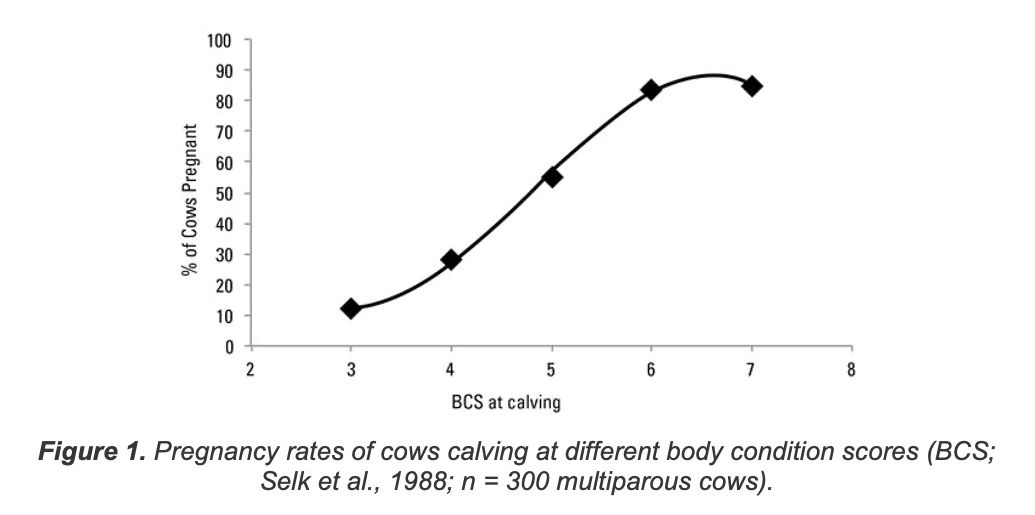
The goal of every beef cow feeding program should be to provide the cheapest diet possible to reduce annual feeding costs, and to provide enough nutrients to prevent reproductive failure. If the cow’s nutrient requirements are not met before calving, they will utilize nutrients from their own body reserves to survive and to maintain fetal calf growth. Consequently, these cows will often calve at a lower than optimum body condition score (BCS). The BCS system is an indicator of the amount of body fat a cow has during the various stages of production. It is a significant factor in determining a cow’s reproductive performance and productivity. In order to conceive at an acceptable rate (>85%), cows must maintain an adequate amount of body condition or fat. A body condition score of 5 (1 to 9 scale) is considered ideal for optimum reproductive performance.
A low BCS at the time of calving (less than 5) extends the anestrous period, which is the period following calving when the cow is not cycling. An extended anestrous period decreases the percentage of cows that are cycling and able to breed at the start of the breeding season, leading to delayed breeding, lower pregnancy rates (Figure 1). and longer breeding and calving seasons. The result is a less uniform calf crop and less time to recover before the next breeding season.
Fetal Programming
Fetal programming is the concept that a maternal influence during fetal development has long-term effects on the offspring. Both cow and calf nutrient requirements are relatively low during the first two trimesters of gestation. Approximately 75% of calf fetus growth occurs during the last two months of gestation. For that reason, it is often assumed that cow nutrition during the last trimester of pregnancy has the greatest effect on calf growth and performance. However, studies have shown that both early and mid-gestation nutrition is also important.
Maximal placental growth, differentiation, and vascularization occur during the early stages of fetal development. The placenta is the major regulator of calf fetal growth, and it is generally agreed that maternal nutrition may affect the development and function of the placenta. In addition, the majority of calf organs form simultaneously with placental development during early gestation. Organs and tissues develop at various times during gestation. For example, organs such as kidneys and pancreas occur during early gestation, whereas muscle and adipose tissue formation occurs primarily during mid to late gestation. Thus, nutrient restriction during any phase of gestation might impact placental formation and calf organ development. Also, depending on when during gestation the nutrient restriction occurs, the outcome of this nutrient restriction might have different effects on calf performance.
Consequences of Nutrient Restriction
Early Gestation (0 to 3 months of gestation)
Cows must conceive within 80 days post calving if a yearly calving interval is to be achieved. Cows’ milk production and nutrient requirements peak at 60 days post calving; however, intake lags behind. This results in negative energy balance during early to mid-lactation, especially in spring calving herds when cows calve during the late winter or early spring seasons when forage is less available and often of poor nutritional value.
A University of Wyoming study evaluated the growth performance and organ development of calves born to cows experiencing nutrient restriction during early gestation. In that study, cows were separated into two groups that were fed either 55 or 100% of their nutrient requirements for the first 83 days of gestation. Both groups were then provided 100% of their nutrient requirements until calving. Cows provided 55% of their nutrient requirements lost 137 pounds of body weight, whereas cows fed 100% of their nutrient requirements gained 95 pounds of body weight during the first 83 days of gestation. However, no differences were observed on calf birth weight, weaning weights, and average daily gain from birth to weaning or during the feedlot finishing phase. However, lung and trachea weights of steers born to heifers provided 55% of their nutrient requirements were significantly less (P < 0.05) than steers born to heifers fed 100% of their nutrient requirements. In the feedlot, calves are constantly exposed to several pathogens and commingled with calves of unknown health background. It is reasonable to assume that smaller lungs could be detrimental to calf performance if those calves experience bovine respiratory disease after entering a commercial feedlot.
Mid Gestation (3 to 6 months of gestation)
Production-oriented tissues, such as muscle, appear to be responsive to fetal programming effects in utero. Muscle formation is divided into two waves of muscle fiber synthesis. The first wave begins at mid gestation, whereas the second wave occurs from six to nine months of gestation. Thus, nutrient restriction during mid gestation is expected to decrease muscle fiber formation, leading to lower birth and weaning weights.
At the University of Wyoming, researchers evaluated the growth performance of steers born to cows grazed on low-quality, native pastures (6% crude protein) or high-quality, fertilized and irrigated pastures (11% crude protein) for 60 days from 120 to 150 days through 180 to 210 days of gestation. In that study, body weight at weaning and carcass weights were reduced for male offspring born to cows grazed on native pastures compared to male offspring born to cows grazed on improved pastures during mid gestation. In addition, the Warner-Bratzler shear force, which is an indicator of meat tenderness, was less for Longissimus muscle samples of male offspring born to cows grazed on improved pastures (31 vs. 37 N; P = 0.004). In other words, cows that grazed on improved pastures during mid gestation produced calves that were heavier at weaning and harvesting, and that had greater meat tenderness at slaughter.
Nutrient restriction during mid gestation also may have consequences on organ development. In another University of Wyoming study, crossbred cows were assigned to one of two groups and fed either 70 or 100% of their nutrient requirements from day 45 to 185 of gestation. They were then commingled and fed at 100% of their nutrient requirements from day 185 of gestation until calving. Although body weight at birth and at weaning did not differ between treatments, heifers born to cows fed at 70% of their nutrient requirements had smaller ovaries and luteal tissue. Luteal tissue is crucial for progesterone synthesis and pregnancy maintenance. Therefore, smaller ovary and luteal tissue could negatively affect heifers’ reproductive performance during their first breeding season.
Late Gestation (6 to 9 months of gestation)
Although all phases of gestation are nutritionally important, late gestation is probably the most important gestation period in terms of potential impact on production-oriented tissues such as muscle and adipose tissue. As mentioned before, major portions of beef cattle muscle and adipose tissue form during late gestation Muscle fiber number is set at birth, meaning that after the calf is born, there is no net increase in the number of existing muscle fibers. Thus, if nutrient restriction during late gestation reduces muscle fiber number, calf growth performance following birth might be compromised. In addition, maternal nutrient restriction may also compromise adipocyte populations (cells responsible for accumulating fatty acids and generating intramuscular fat, for example), resulting in carcasses with lower quality and marbling scores.
Studies from the University of Nebraska measured the effects of protein supplementation during late gestation on subsequent calf performance. During late gestation, cows were fed either no supplemental protein or 1 lb./day of a 42% protein supplement.. At weaning, male calves born to cows’ protein-supplemented cows were heavier than male calves born to non-supplemented cows. In addition, males born to protein-supplemented cows had heavier carcasses than males from non-supplemented cows. They also had a higher percentage of carcasses grading Choice, and greater marbling scores than males from cows that received no protein supplementation during late gestation.
These studies also evaluated the effects of protein supplementation during late gestation on heifer performance. Weaning weights and 205 day adjusted weaning weights were greater for heifers born to cows that received protein supplementation during late gestation. In addition, heifers born to protein-supplemented cows achieved puberty at younger ages and had greater pregnancy rates than heifers born to cows that did not receive protein supplementation.
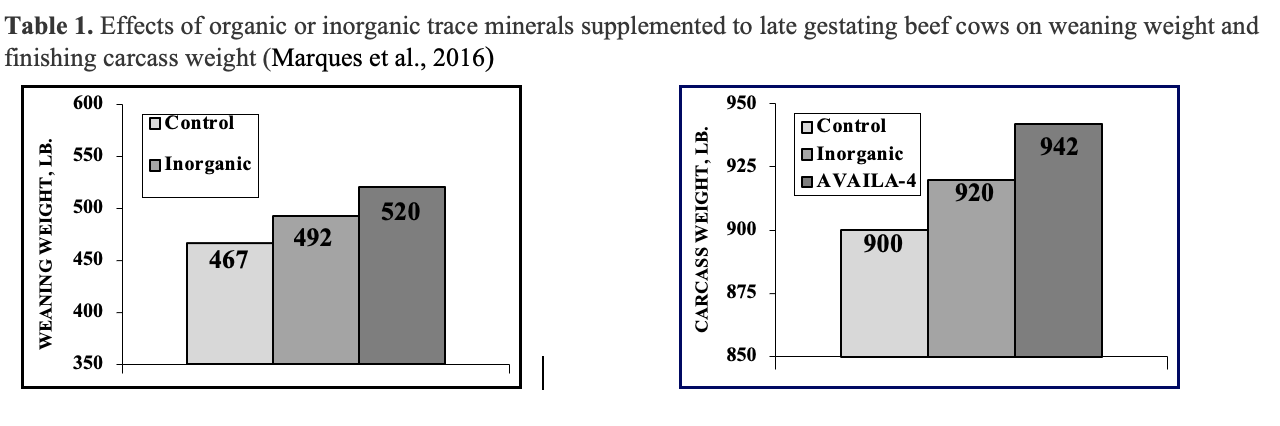
In addition to protein, mineral nutrition is also important to the cow during gestation. Research shows that optimal trace mineral nutrition during gestation can positively affect embryo and fetal development resulting in improved calf health and growth performance. A study at Oregon State University (Table 1) showed that calves from cows supplemented with either conventional, inorganic trace minerals or complexed, organic trace minerals (AVAILA-4, Zinpro Corp.) during the last trimester of pregnancy were heavier at weaning and maintained that weight advantage throughout the feedlot phase. In addition, calves were preconditioned 45 days following weaning. Calves born to cows supplemented with the complexed, organic trace minerals required less BRD treatments.
Final Comments
Nutrient deficiency often occurs in beef cow herds fed forage-based diets due to seasonal variation in forage quality and quantity and, as a result of management leading to overgrazed pastures and lower hay quality. Overcoming these nutrient deficiencies during gestation has been shown to not only improve the reproductive performance of the cow herd, but also the subsequent growth, feedlot performance, meat quality and reproductive performance of the calf crop. The effect of good nutrition during gestation and the subsequent better lifetime calf performance is what we call “Fetal Programing”. Therefore, it makes sense that good forage management, along with optimum cow nutrition can help prevent the negative impacts of nutrient restriction during gestation on cow and calf performance.
Western Feed Mills, Inc. has a complete line of Range Feeds and Mineral Supplements that provide the protein, energy, minerals and vitamin nutrition that high-performing beef herds need throughout the year. Contact your Western Feeds representative or call us at 1-630-785-2283 for more information on how Western Feeds products can work for you.
References
Adapted from; Fetal Programming: Cow Nutrition and its Effects on Calf Performance. Philipe Moriel, Extension Mountain Livestock Specialist Animal Science, North Carolina Cooperative Extension. 2016.